|
I.A.T.S.E. LOCAL 27
More than a century behind the curtain.
● ● ● ● ● ● ●
The People Behind Cleveland's StagesSince its charter in 1894, I.A.T.S.E. Local 27 has been part of Cleveland's entertainment history. These photographs preserve pieces of that story — the theaters, stagehands, labor actions, social gatherings, celebrations and changing technology that shaped generations of work behind the curtain. These images were preserved in Local 27's historical collection and are now being digitized, researched and shared as part of an ongoing effort to preserve the history of Cleveland's theatrical stagehands. This archive is a work in progress, and we hope to continue adding photographs, names, dates and stories as new information is discovered. Some photographs are well documented. Others still hold mysteries. Dates identified as approximate reflect the best information currently available, and original handwritten album notes have been preserved even when later research suggests they may refer to a theater's opening year rather than the photograph itself. 🔍 CLICK ANY PHOTOGRAPH TO VIEW THE FULL-SIZE IMAGE
AFTER 1889
Lyceum Theatre — Public Square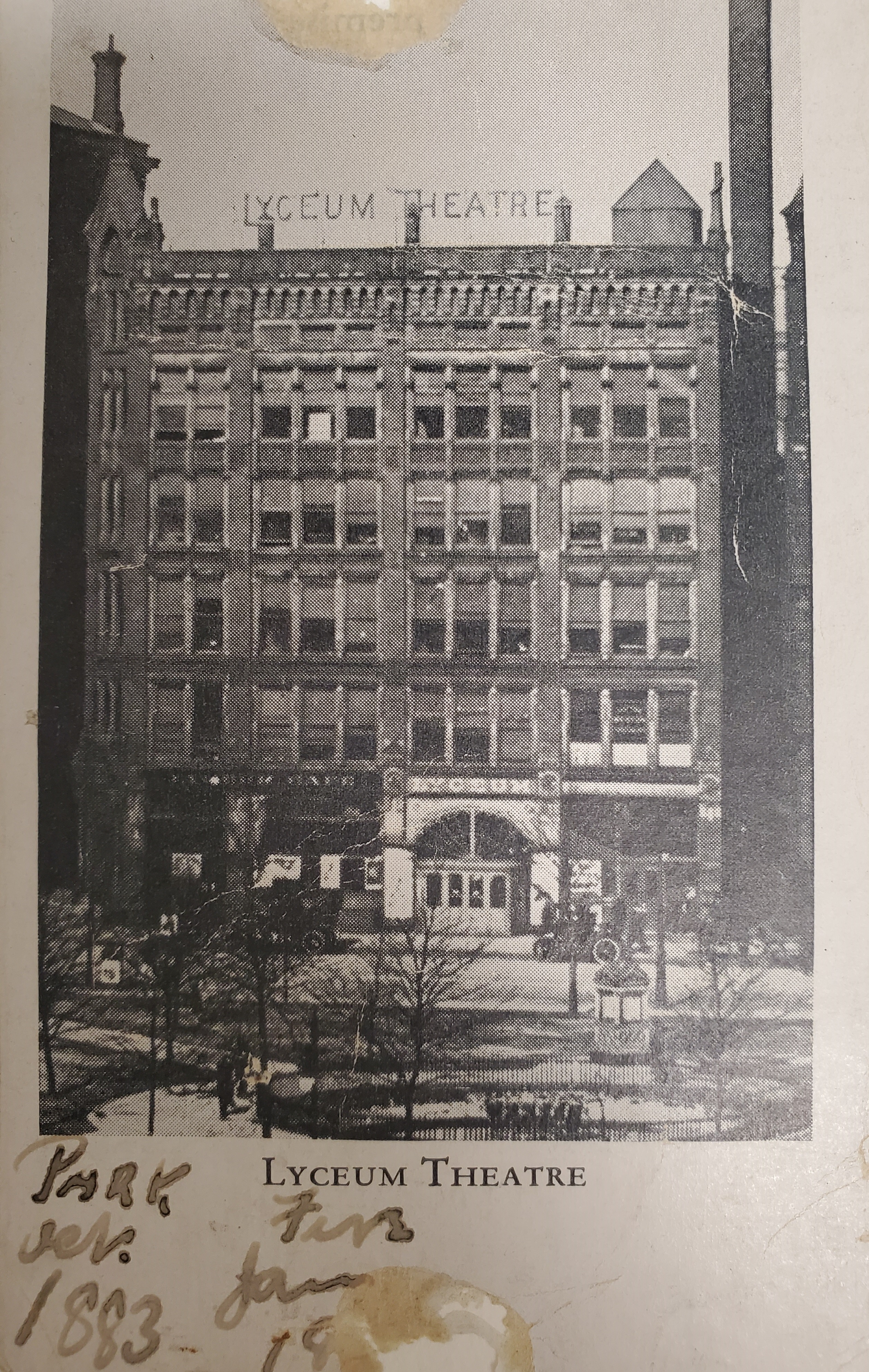
Collection of IATSE Local 27 A historic glimpse into the birth of Public Square's premier showpiece. This photograph shows Cleveland's landmark theatre on Public Square, in the Wick Block on the northwest quadrant, right next to the Old Stone Church — a stunning landscape view of the building that first captivated the city as the Park Theatre. When it opened its doors on October 22, 1883, the grand venue instantly drew attention with its sprawling orchestra circle, multi-tiered balconies, and an opulent interior beautifully decorated in the popular Moorish style. Though the original building tragically burned down just a year later, in January 1884, it was quickly rebuilt and eventually renamed the Lyceum Theatre in 1889. For decades, it stood as a crown jewel of downtown culture, welcoming legendary international stars like the famous French actress Sarah Bernhardt to its stage, before the building was eventually demolished in 1913. The handwritten album notation appears to reference "Park" and 1883. However, 1883 cannot be the date of this particular photograph, since the rooftop sign clearly reads "Lyceum Theatre" — a name the building didn't carry until 1889, six years after its debut as the Park. This turned out to be an important clue when researching the collection: some handwritten dates appear to record a theater's original opening year rather than the year the photograph was actually taken. ARCHIVE NOTE: Local 27 was chartered in 1894, placing the Lyceum squarely within the working world of the Local's earliest generation. The exact date of this photograph remains under research.
LIKELY c. 1890s
Star Theatre — 709 Euclid Avenue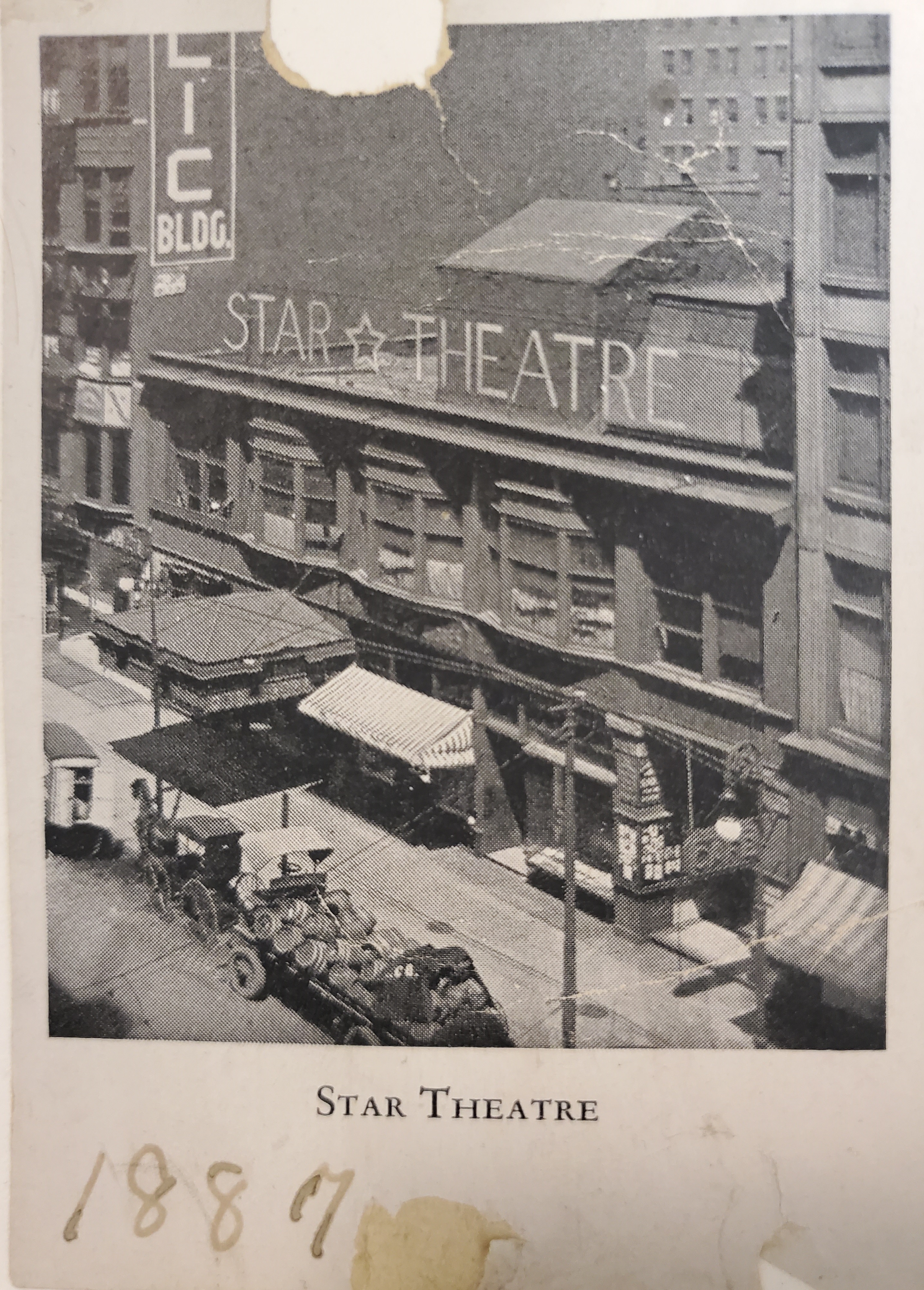
Collection of IATSE Local 27 A horse-drawn look at the rowdy roots of Cleveland nightlife. The album identifies this building as the Star Theatre, a fact confirmed by the enormous rooftop sign — a street-level view of the facade on Euclid Avenue downtown, with a horse-drawn carriage waiting out front. The theater at 709 Euclid Avenue originally opened as the Columbia Theatre in 1887, before being freshly renamed the Star Theatre in 1889 under the management of local showmen W. Scott Robinson and Frank M. Drew. Under its new name, the venue was at the absolute vanguard of the city's entertainment scene, presenting vaudeville, melodrama, comic opera, and, later, burlesque. The horse-drawn carriage waiting outside captures Cleveland at the turn of an era, when the city's streets were beginning a dramatic transformation. In its early days as the Star, the theater catered to patrons looking for high-energy comic operas and vaudeville shows, before later evolving into the city's premier "refined burlesque" house. This photograph preserves the raw, turn-of-the-century charm of Euclid Avenue's earliest theatre pioneers, on a site that would later go on to house the Cameo and Embassy Theatres. The handwritten "1887" on the album therefore appears to commemorate the building's original opening as the Columbia rather than the date the photograph was actually taken, since the rooftop signage already reads "Star." Horse-drawn traffic visible on Euclid Avenue makes an early date quite plausible, with c. 1890s currently serving as a cautious working estimate. DID YOU KNOW? The theater was later converted to show silent motion pictures as the Cameo Theatre. Most of the structure was razed in 1938 to make way for the Embassy Theatre.
TURN OF THE 20TH CENTURY
Empire Theatre — Huron Road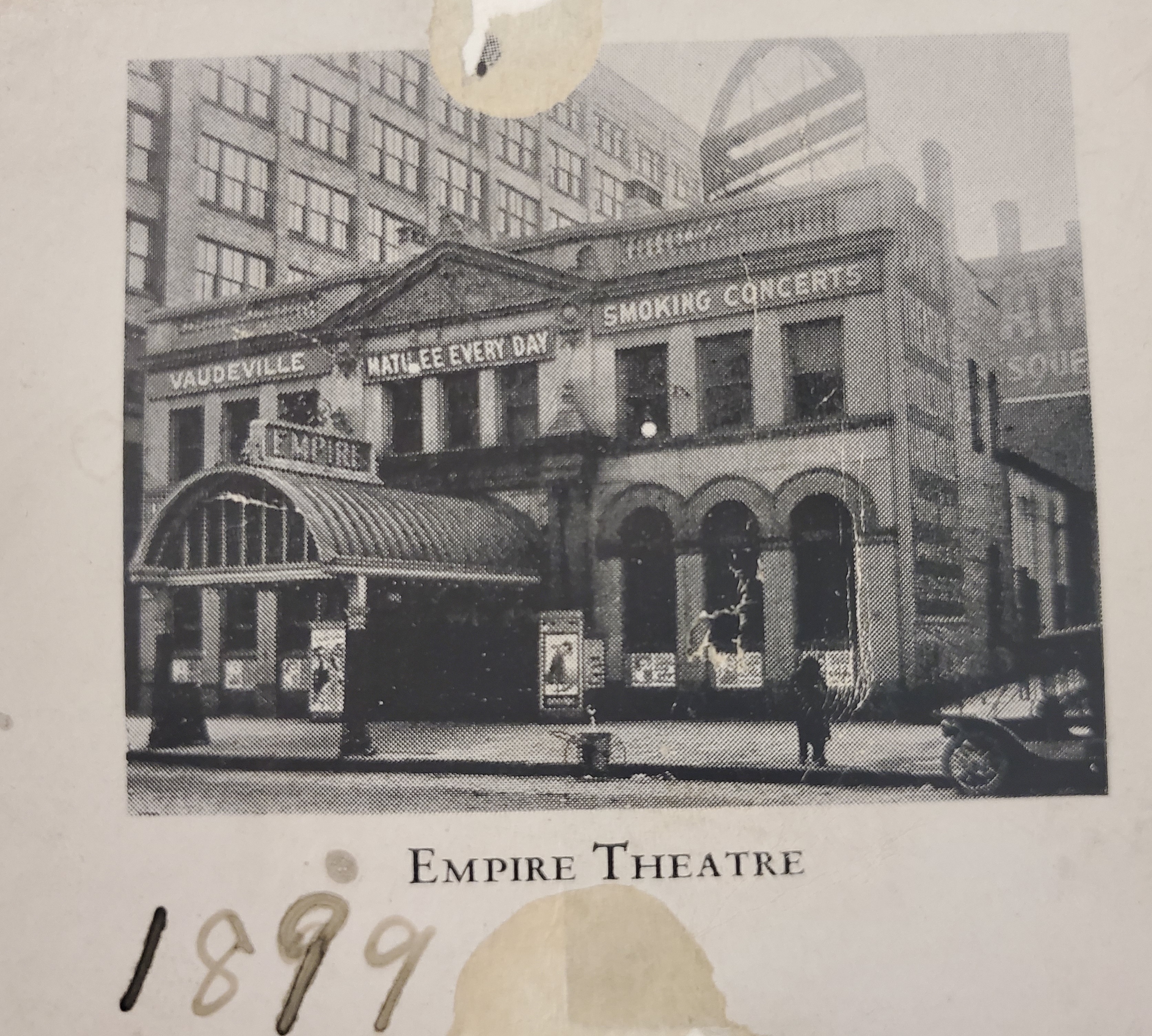
Collection of IATSE Local 27 A smoky, high-energy look at the birth of Cleveland vaudeville. Here we glimpse the dawn of 20th-century nightlife: the freshly built facade of the Empire Theatre at 788 Huron Avenue downtown, its crown boldly advertising "Vaudeville — Matinee Every Day — Smoking Concerts." Designed by local architect Morris Gleichman, the Empire made history as the very first venue in Cleveland constructed specifically for the vaudeville circuit, and it quickly became one of the city's important early vaudeville houses. The bold text painted across the building's crown tells you exactly what kind of experience awaited inside. "Smoking Concerts" were immensely popular events where Victorian social rules were happily cast aside, allowing patrons to smoke cigars, drink beer, and cheer for top-tier specialty acts. The Empire belonged to a fascinating transitional period in American entertainment, when vaudeville, live theater, burlesque, and the emerging motion-picture industry increasingly shared audiences and stages. Before the building was eventually replaced by the Ohio Bell Building in the 1920s, this historic stage hosted legendary performers ranging from early film star Charlie Grapewin to the world-renowned escape artist Houdini. ARCHIVE MYSTERY: The album this photograph came from appears to be marked 1899. Historical sources place the Empire's opening around 1900, so the annotation is being preserved here while the exact chronology continues to be researched.
THE EARLY STAGEHANDS
1903
Two extraordinary glimpses of Cleveland theater crews.
Lyceum Theatre Crew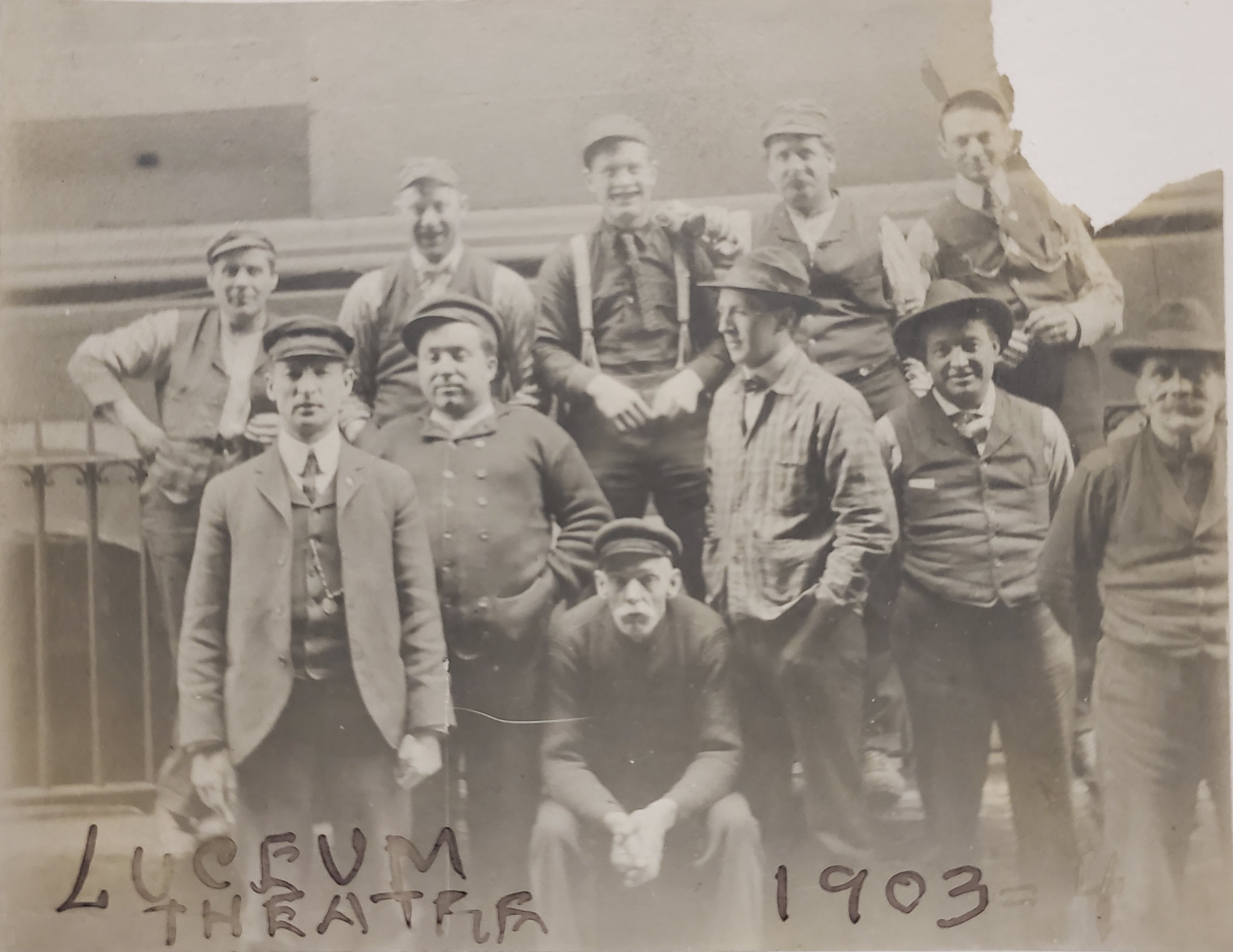
Collection of IATSE Local 27 The hidden architects behind the grand productions of 1903. Handwritten directly on this remarkable photograph are the words "Lyceum Theatre 1903," identifying an intimate portrait of eleven backstage stage crew members at the Lyceum Theatre — a historic name sharing roots with Cleveland's Public Square and Broadway's landmark 1903 opening. This striking photograph honors the men who operated the levers of early 20th-century show business, at a moment when 1903 marked a monumental turning point for the theatrical world, witnessing massive technical advancements in staging and the birth of legendary new venues. Their work clothes, caps, suspenders and shop coats strongly suggest men involved in the practical operation of the theater. A major playhouse of the period depended on stage carpenters, property workers, electricians and other backstage crafts to handle scenery, rigging, lighting and the physical demands of live production. Their appearance and surroundings strongly suggest a group involved in the practical, physical work of operating the theater — the essential foundation on which turn-of-the-century popular entertainment was built. By 1903, Local 27 had been chartered for nine years, and because this photograph survives in the Local's historical collection, it is quite possible that some or all of these men were early Local 27 members. Until membership records or another contemporary source identifies them, however, that connection remains probable rather than proven. HELP US IDENTIFY THEM: Period theatrical directories may eventually allow names to be attached to stage managers, carpenters, electricians, property men and other members of this crew.
Colonial Theatre Crew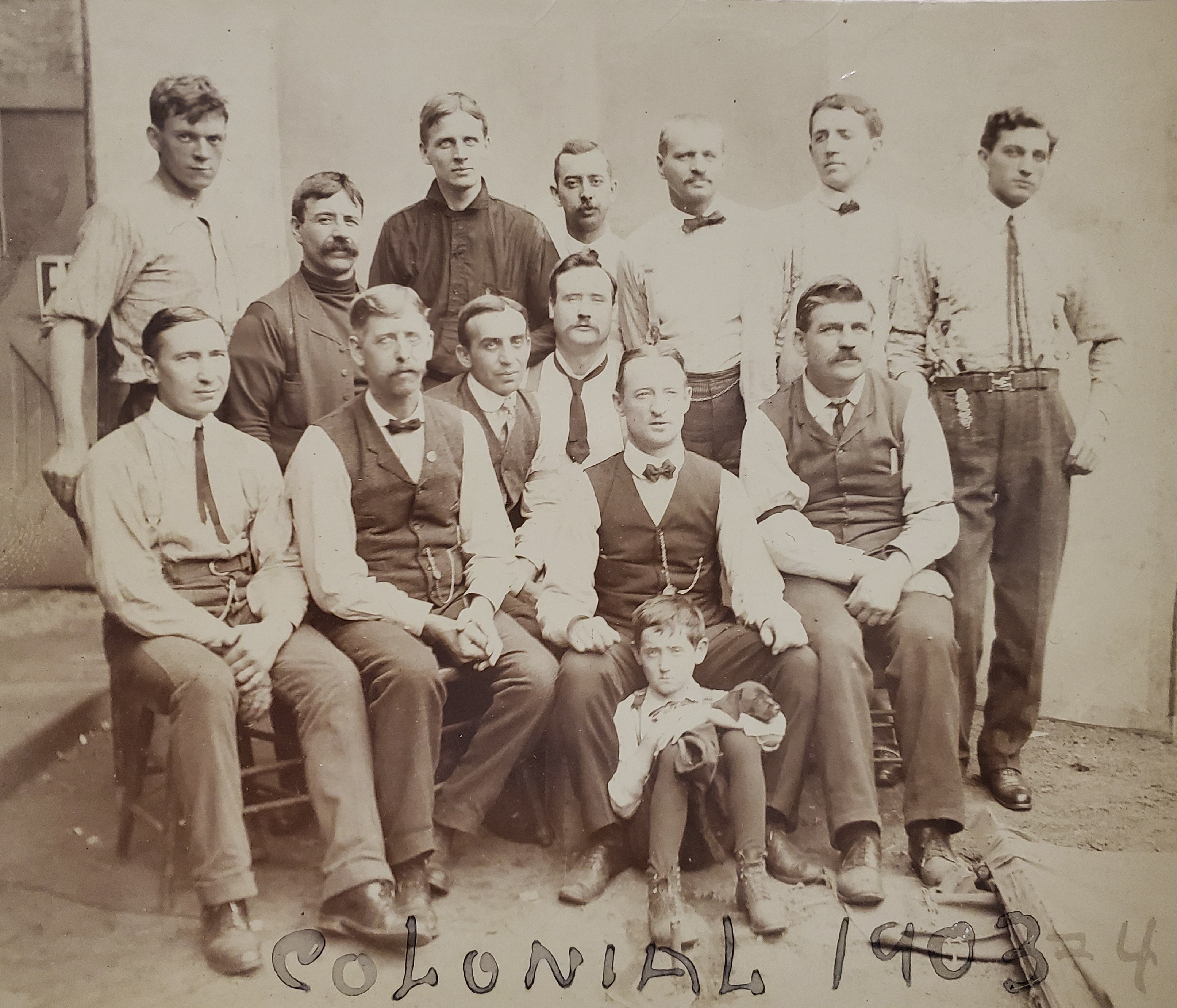
Collection of IATSE Local 27 Behind the magic of Cleveland's grand opening night. Handwritten simply "COLONIAL 1903," this remarkable group portrait appears to date from the opening year of Cleveland's Colonial Theatre. The theater opened on March 16, 1903, near Superior Avenue and Erie Street — today's East 9th Street — with seating for approximately 1,472 patrons. The photograph shows thirteen men and one young boy gathered together outside the theater, accompanied by a small puppy tucked into the center of the group. Their work clothes, caps, suspenders and shop coats strongly suggest men involved in the practical operation of the theater. A major playhouse of the period depended on stage carpenters, property workers, electricians and other backstage crafts to handle scenery, rigging, lighting and the physical demands of live production. Because Local 27 had already been chartered for nearly a decade when this photograph was taken, it is tempting to imagine that some of these men were among the Local's early members. For now, however, their names, individual jobs and Local 27 membership remain unconfirmed. ARCHIVE MYSTERY: More than 120 years later, the identities of the men — and the young boy — pictured here have been lost to time. Local 27 is continuing to research early membership records, theater directories and other historical sources in hopes of putting names to some of these faces.
c. 1904–1908
Keith's Prospect Theatre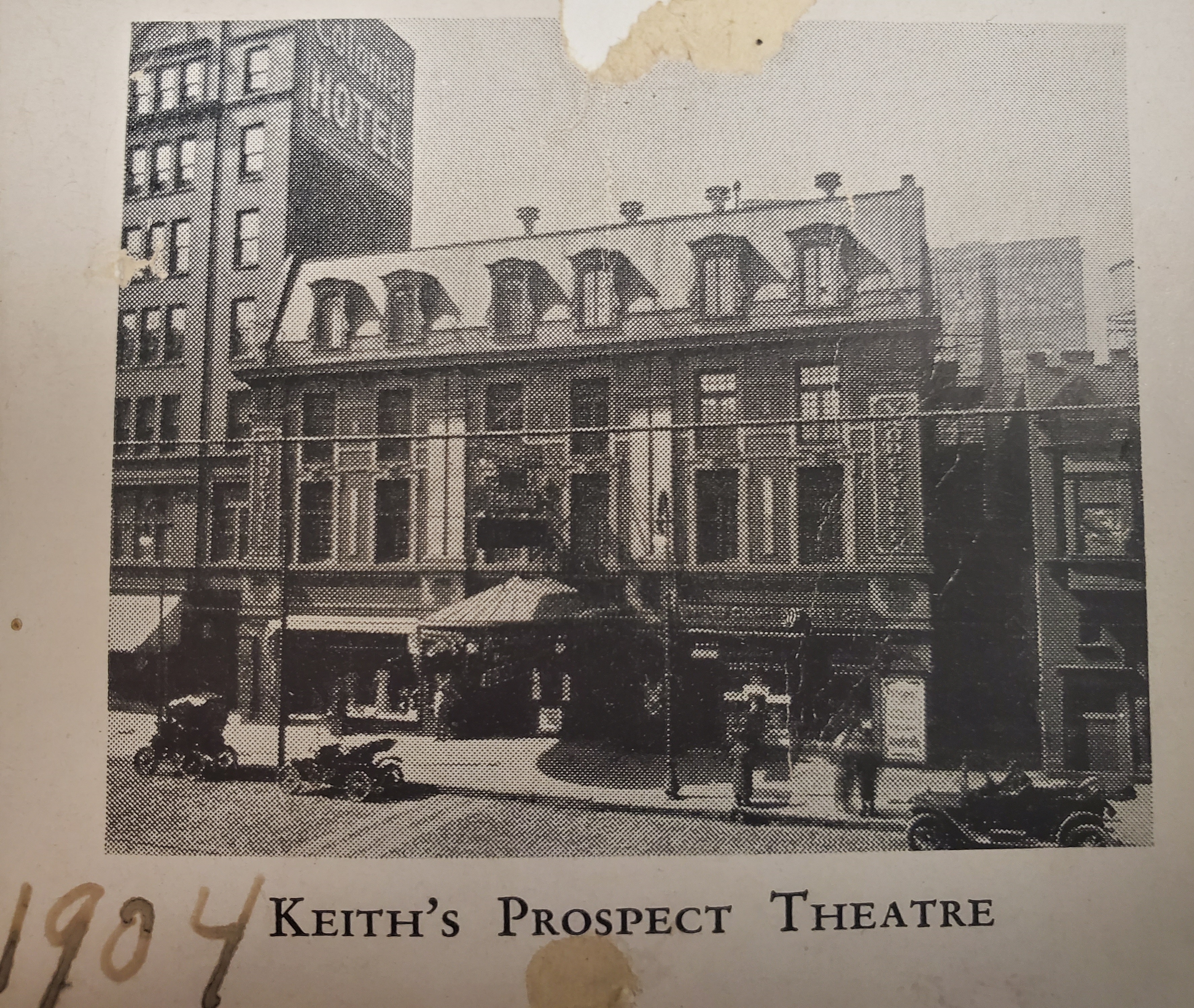
Collection of IATSE Local 27 A bustling turn-of-the-century look at Cleveland's emerging theater hub. Here is a vibrant moment in our city's theatrical evolution: a street-level view of Prospect Avenue, in the heart of downtown Cleveland's business and shopping district, showing the theater that would become Keith's Prospect with the prominent Colonial Hotel building visible directly to its left. The venue originally opened in April 1904 as the Prospect Theatre, and was quickly acquired that same autumn by entertainment magnate B. F. Keith, who reimagined it as a high-class vaudeville house. It soon became associated with Keith's powerful vaudeville organization and an immediate sensation on the local scene. The photo beautifully highlights the neighborhood's bustling nightlife layout. Travelers staying at the neighboring Colonial Hotel — famous for its stunning architecture and central location — could walk right out the front doors and instantly catch top-tier variety acts, comedy routines, and early silent film screenings. The theater belonged to a booming Cleveland entertainment world in which vaudeville circuits, stock companies, and the new motion-picture business increasingly overlapped. Though it ultimately closed in 1923, it helped set the stage for Cleveland to become one of the premier theater destinations in the nation. The album's handwritten "1904" corresponds to the theater's opening year. Because the building already appears to carry Keith identification in this photograph, a working date of approximately 1904–1908 is a more cautious estimate than assuming the image was taken on opening day itself. SEPTEMBER 12, 1933
First Annual Theatrical Pleasure Club Clam Bake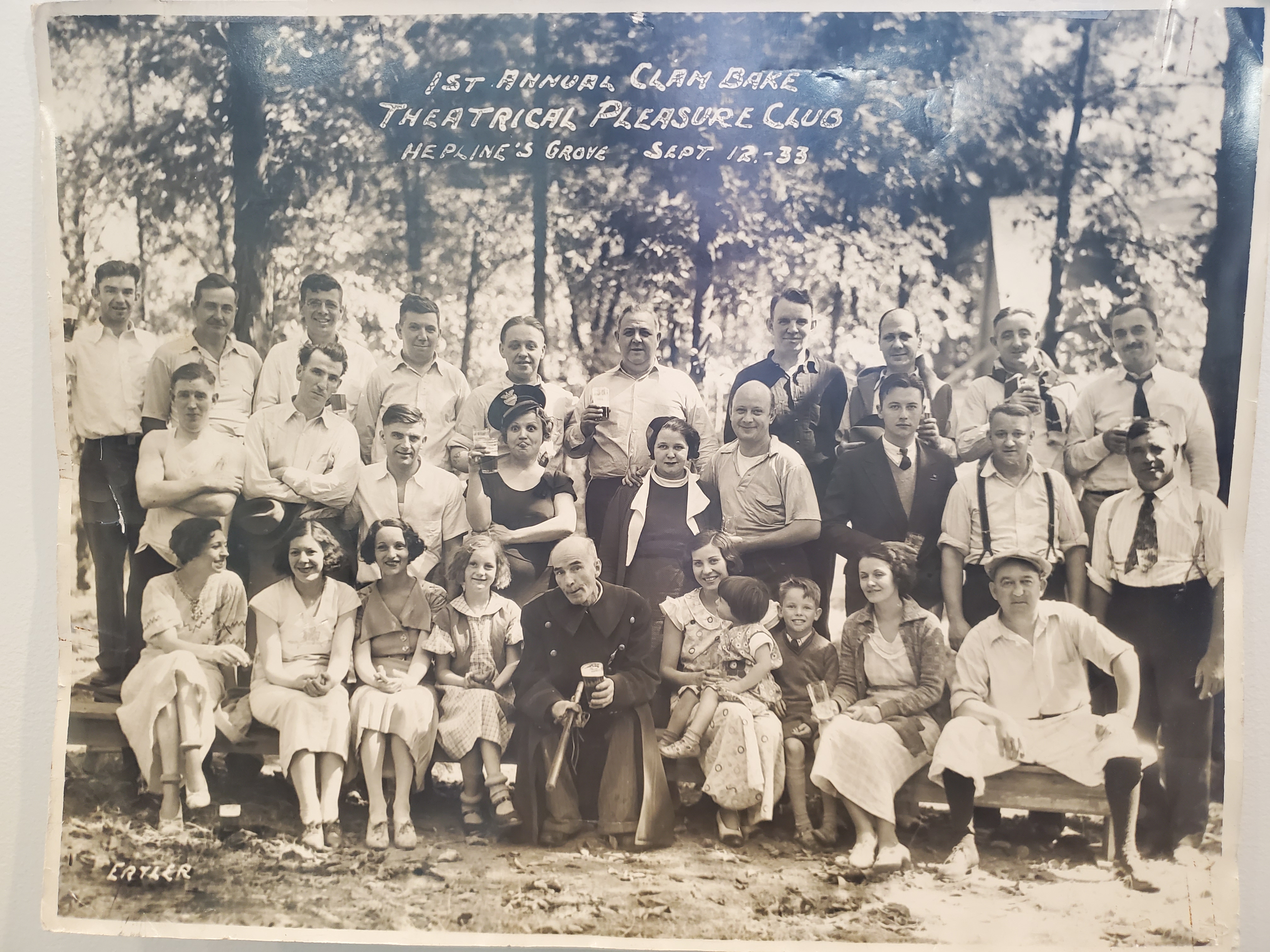
Collection of IATSE Local 27 A rare window into Cleveland's Depression-era stage scene. This wonderful group photograph documents the First Annual Clam Bake of the Theatrical Pleasure Club, held at Hepline's Grove on September 12, 1933. Unlike many photographs in the collection, the handwritten inscription gives us an exact event, place name and date — although the location of Hepline's Grove itself remains a mystery. Taken during the depths of the Great Depression, the photograph offers a rare glimpse into the social life surrounding Cleveland's theatrical community. Men, women and children crowd together for the camera, preserving a side of theater history that happened away from the stage: friendships, families and the social traditions shared by people connected to the industry. Look closely and you'll see a community defiantly celebrating camaraderie, resilient spirits, and quite likely, the imminent end of Prohibition. RESEARCH IN PROGRESS: A potentially interesting lead is Ray Hepline, identified in a 1920s theatrical publication as a Cleveland stage manager. Whether Hepline's Grove had any connection to him has not yet been established. The photographer's mark appears to read "Ertler." Miller-Ertler Studios was a prominent commercial and industrial photography studio based in Cleveland, active during the mid-20th century — notably from the 1930s through the 1950s. They specialized in industrial, architectural, and commercial photography, documenting factories, trade shows, corporate operations, and cityscapes — possibly a clue worth following as this research continues.
ESTIMATED c. late 1920s–1930s
Local 27 Pickets the Cleveland Play House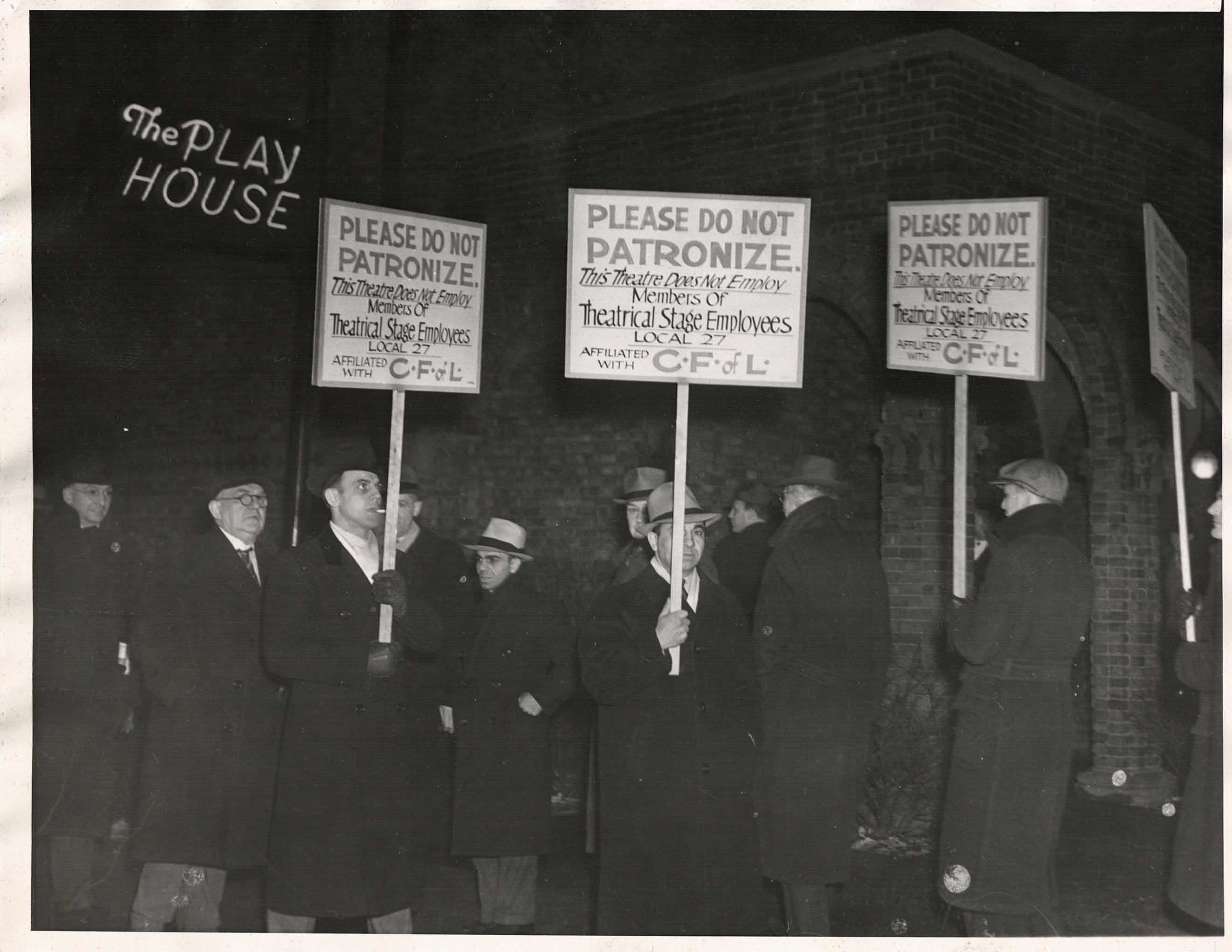
Collection of IATSE Local 27 A high-stakes clash between art and organized labor in Cleveland. There is no mystery about the union represented in this photograph. A group of picketers stands outside the Cleveland Play House — near the historic Drury or Brooks theatre complex on Euclid Avenue and E. 86th Street — carrying signs reading: "PLEASE DO NOT PATRONIZE.
This Theatre Does Not Employ Members Of Theatrical Stage Employees LOCAL 27." Dated to the late 1920s or 1930s, the scene captures a turbulent era in the city's cultural history. While the Cleveland Play House gained national acclaim for its artistic innovations, its insistence on running as a non-union shop created immense tension with the local labor movement. Dressed in the sharp, dramatic overcoats and wide-brimmed hats of the era, these members of IATSE Local 27 and the Cleveland Federation of Labor formed a united front on the sidewalk, explicitly urging theater patrons to boycott the venue until it recognized union workers. The photograph is a direct piece of Local 27 labor history: members publicly advocating for union stagehand employment at one of Cleveland's major theatrical institutions. This decades-long dispute eventually transformed the theater industry, ultimately leading the Play House to formally partner with union stagehands and theater groups to become the professional theatrical powerhouse it is today. DO YOU KNOW THESE MEN? The identities of the picketers in this photograph have not yet been established. If any of these men can be identified through Local 27's membership rolls or another contemporary source, it would add a valuable name-to-face record to this chapter of the Local's labor history.
SEPTEMBER 1941
Playhouse Square in Its Heyday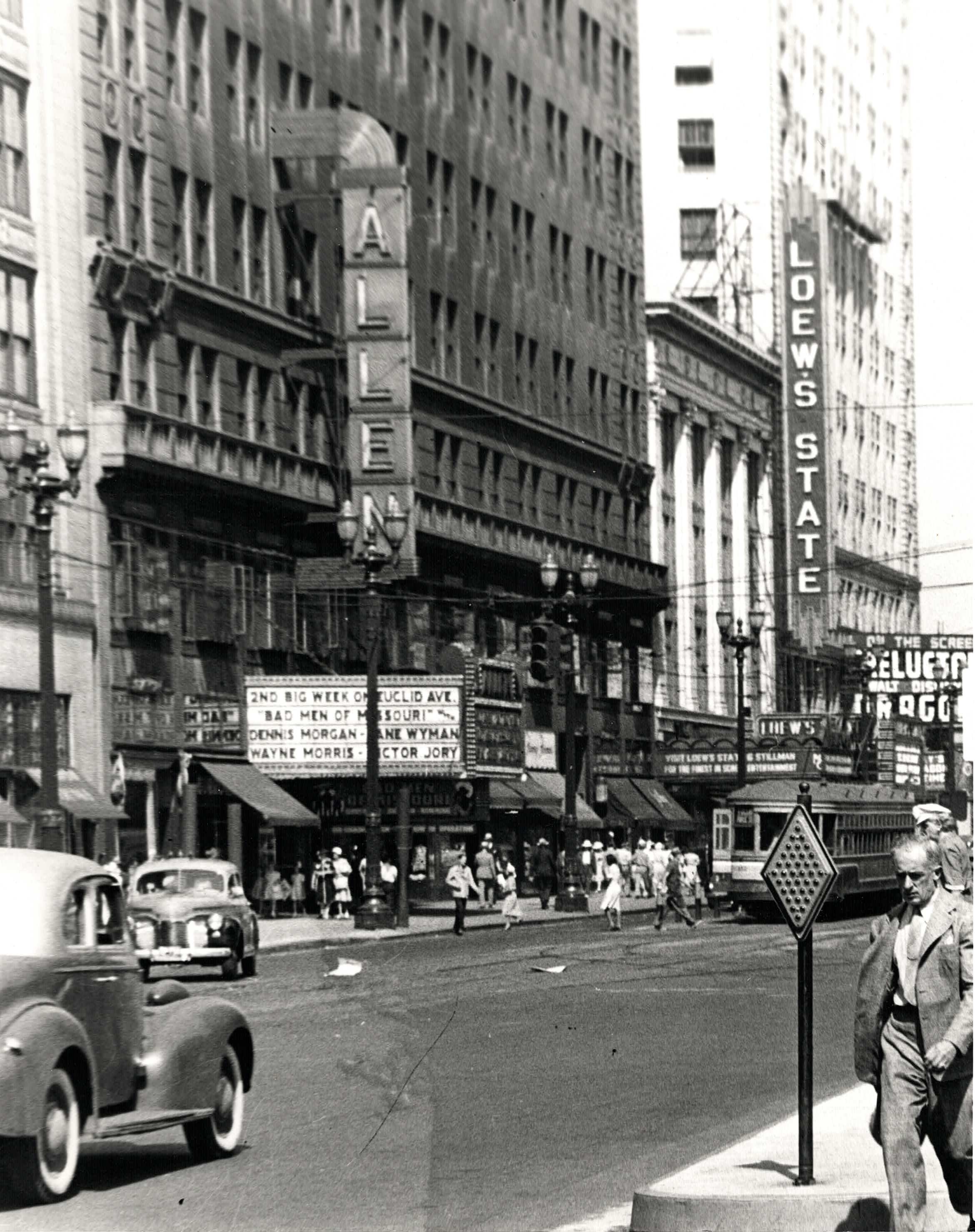
Collection of IATSE Local 27 A bustling, late-summer look at the heart of Cleveland's Playhouse Square. Looking east down Euclid Avenue at E. 14th Street toward the neon marquees of the Allen, Loew's State, and Stillman Theatres, this streetscape captures the absolute zenith of downtown Cleveland's movie palace era. Captured in September 1941, just months before the United States entered World War II, the photo shows Playhouse Square not as a restored historic district but as a living Cleveland entertainment center, with Euclid Avenue lined with towering marquees and still operating at full throttle. The Allen Theatre dominates the left side of the photograph, while the enormous vertical "Loew's State" sign rises farther down the street among automobiles, streetcars, and theatergoers. The signs reveal a perfect double-feature era of Hollywood history. The Allen is prominently showcasing the new Warner Bros. Western "Bad Men of Missouri," while its immediate neighbor, Loew's State Theatre — boasting what was then celebrated as the longest single-theater lobby in the world — stands side-by-side with the Stillman Theater. Look closely at the Stillman's marquee, and you can spot a rare billing advertising a premier package of iconic Walt Disney Technicolor cartoons on the big screen. The Allen marquee also gives us a detective-worthy clue for dating the photograph. It advertises "Bad Men of Missouri," starring Dennis Morgan, Jane Wyman, Wayne Morris, and Victor Jory, and billed as being in its "2nd Big Week on Euclid Ave." The film premiered nationally on July 26, 1941, and by working forward through its theatrical run — first-run engagements followed by subsequent downtown bookings — that "second week" placement lines up with a date in September 1941, firmly anchoring the photograph in that late-summer moment just months before Pearl Harbor. SEPTEMBER 1, 1942
Cleveland Labor's Message to Hitler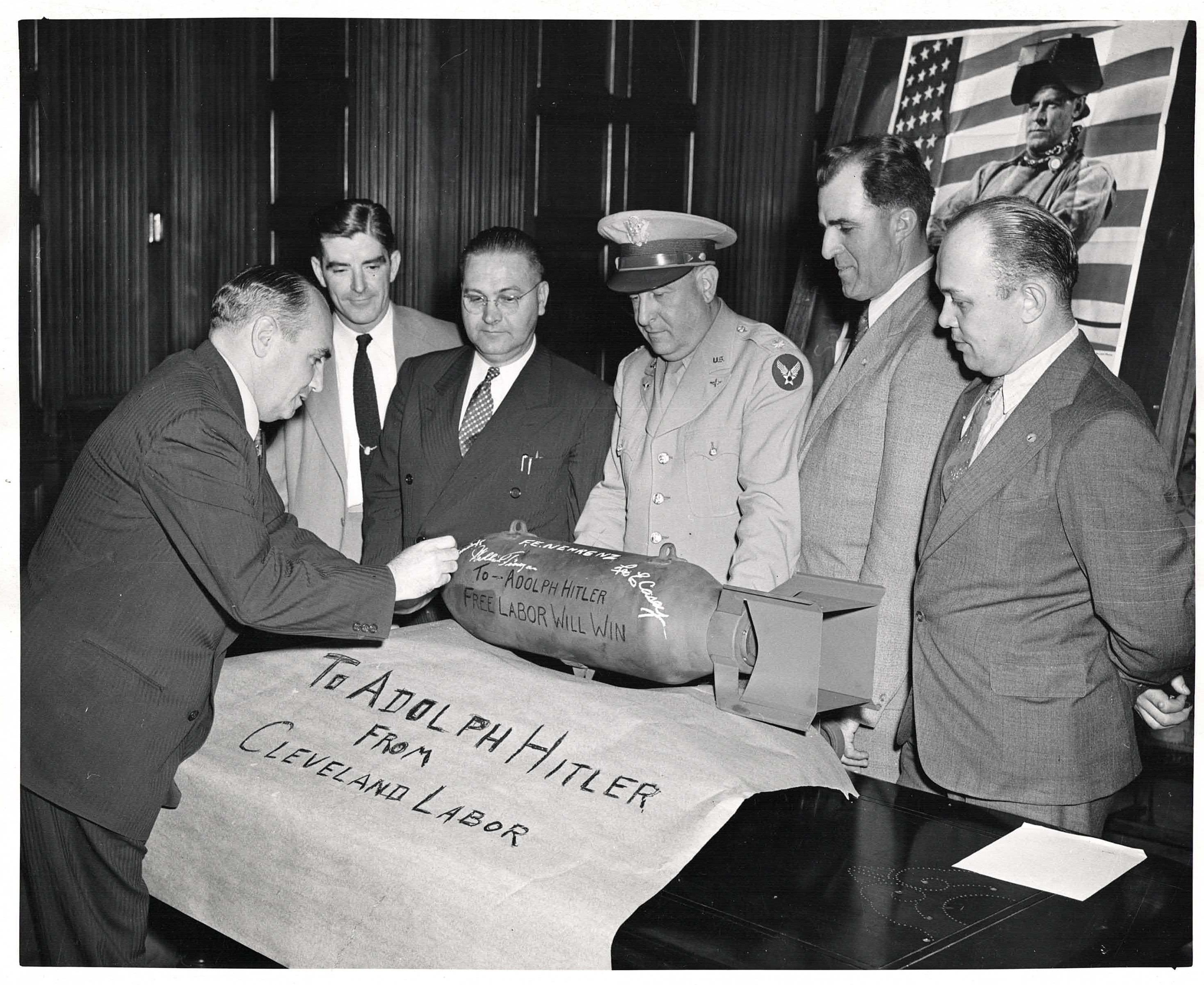
Collection of IATSE Local 27 Defiant home front patriotism on Cleveland's production lines. Written prominently on the bomb are "To — Adolph Hitler" and "Free Labor Will Win," while the cloth draped beneath it reads "To Adolph Hitler From Cleveland Labor." This unforgettable photograph brings us face-to-face with the high-stakes determination of Cleveland's wartime workforce. On September 1, 1942, Cleveland labor leaders gathered at the War Production Board headquarters downtown and autographed a U.S. Army Air Forces bomb intended for delivery to Germany, sending a direct, unyielding message from Northeast Ohio's production lines straight to the Axis powers. Six men, including a uniformed member of the Army Air Forces, are shown signing the bomb casing. Two signatures have drawn particular interest during research: one appears to read Leo Casey, and a separate federal wartime record identifies a Leo Casey as a Cleveland-area labor adviser affiliated with the CIO's United Steelworkers. Another appears to read F. E. or Frank Nehrenz, and a Cleveland directory record turns up an F. E. Nehrenz active in an organization at the time — though neither lead has proven strong enough to conclusively identify either man in this specific photograph. Unlike some of our mystery pictures, the event, place, and date here are confirmed by an excellent contemporary source: the federal Office of War Information's wartime publication Victory reported the story one week later, on September 8, 1942, under the memorable headline "Pineapple for Adolf!" The article noted that approximately 20 high-ranking labor officials signed the bomb, and that it was intended for delivery to Germany by the Army Air Forces "at their earliest convenience." What we know: Cleveland, September 1, 1942; War Production Board headquarters; Cleveland labor officials; an actual Army Air Forces bomb; approximately 20 labor leaders signed it. What we don't know: Who these six men are, and which unions they represented. LOCAL 27 CONNECTION: The photograph's presence in the Local 27 archive makes its history particularly interesting, but the identities and Local 27 connection of the men pictured are still being researched.
75 YEARS BEHIND THE CURTAIN
Local 27's Diamond Jubilee1894 — 1969
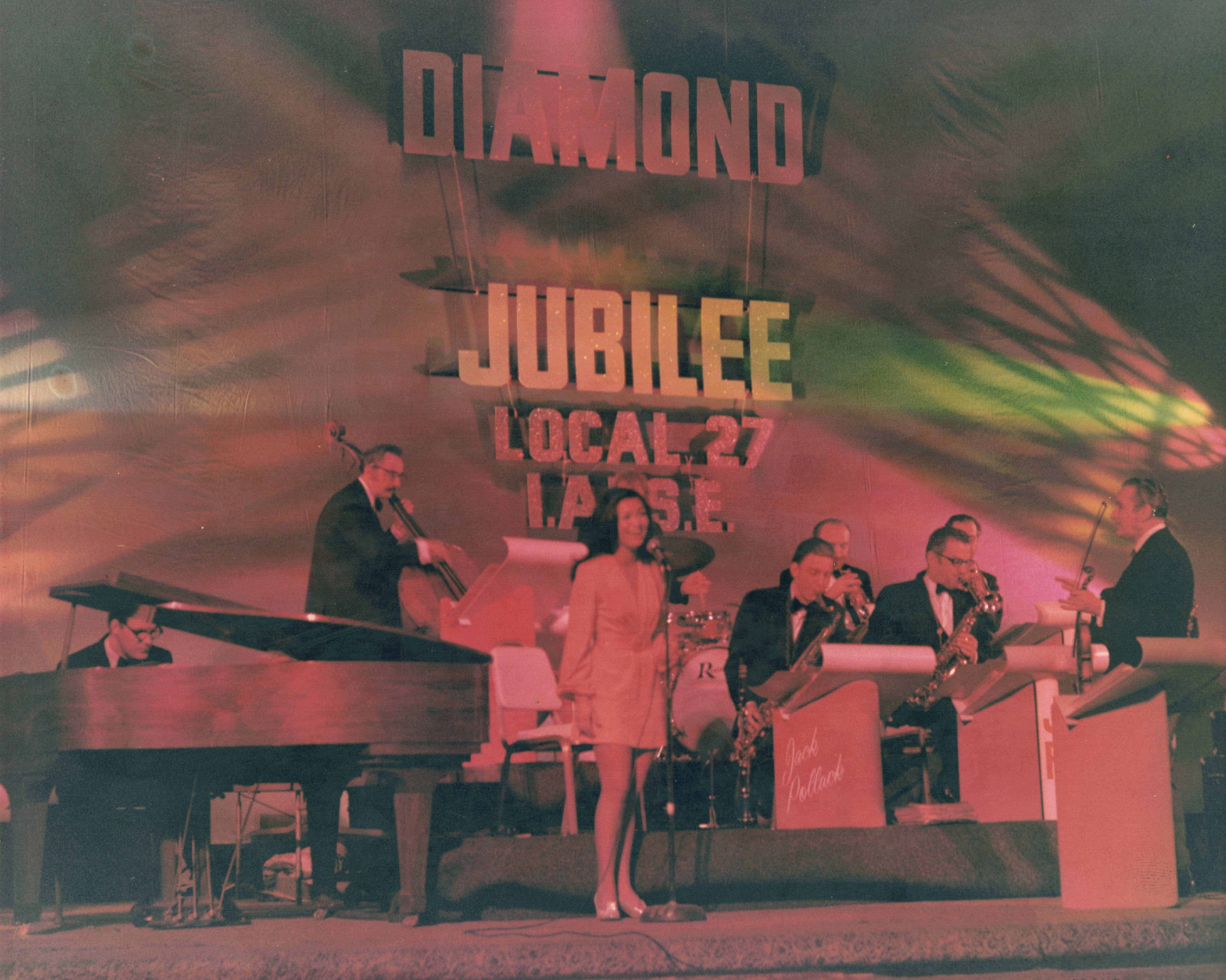
Collection of IATSE Local 27 I.A.T.S.E. Local 27 Diamond Jubilee (1969)A vocalist and live orchestra perform beneath enormous suspended lettering reading "Diamond Jubilee — Local 27 — I.A.T.S.E." while colorful theatrical lighting washes the stage and backdrop. In 1969, I.A.T.S.E. Local 27 celebrated its Diamond Jubilee — 75 years representing Cleveland's theatrical stagehands. Chartered in 1894, Local 27 had by this time witnessed an extraordinary transformation in Cleveland entertainment: from gaslit and early electric theaters, vaudeville, and touring theatrical companies, to motion pictures, major concert productions, television, and the modern entertainment industry. The orchestra leader's music stand appears to bear the name Jack Pollack — a promising clue still being researched, though a Cleveland-area bandleader by that name has not yet been confirmed in any period record. The photograph could hardly be more appropriate for a stagehands' anniversary. The rigging, suspended lettering, lighting, microphones, bandstands, and overall presentation surrounding the performers showcase the very backstage crafts practiced by Local 27's members — the union's own handiwork framing the celebration of its own history. Seventy-five years of making everyone else look good from behind the scenes. ESTIMATED c. 1970s
Stagehands at Work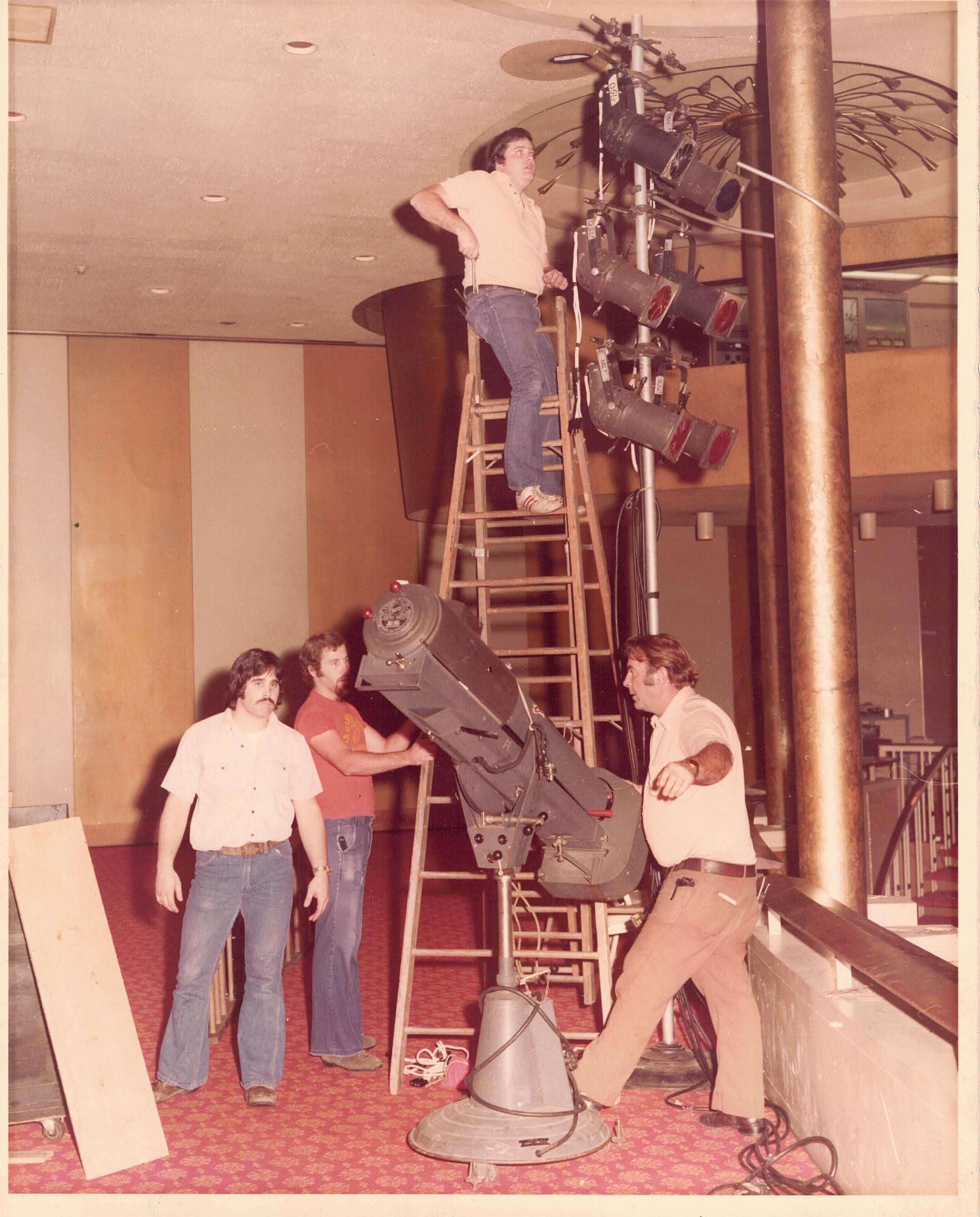
Collection of IATSE Local 27 Stagehands at Work Four Local 27 stagehands are captured at work in this terrific behind-the-scenes photograph: from left, Tommy Holden, Rick Zitello, Chuck Teufel (on the ladder), and Del Driscoll. The photograph offers a great glimpse into the everyday work of a stagehand during the 1970s. A large period followspot dominates the foreground while multiple conventional lighting instruments are mounted on the vertical pipe behind it. Ladders, cables, tools and equipment surround the crew — a working environment that will look very familiar to generations of Local 27 members, even as the technology has changed. STILL A MYSTERY: We have the stagehands — now we need the stage! The exact venue, event and date remain unidentified. The room's distinctive gold columns, red carpeting and architectural details may eventually provide the clue that solves the rest of the story.
HELP US WRITE THE NEXT CAPTION
Recognize Someone?History doesn't live only in archives. Many of the people, venues and events in these photographs are still waiting to be identified — and you may know the answer. If you recognize a Local 27 member, family member, theater, event or location pictured here, we'd love to hear the story. Even a name, approximate year or small detail may help us solve one of the mysteries in this collection. Have Historic Local 27 Photos?
We're looking for more! If you or your family have photographs, programs, union memorabilia, crew pictures, event photos or other pieces of Local 27 history tucked away in an album, attic, drawer or old shoebox, please consider sharing them with us. You don't have to know who everyone is or exactly when a photograph was taken. Sometimes the smallest clue is enough to start the detective work. Help us preserve the stories of the people who built Cleveland's shows from behind the scenes. SHARE A PHOTO OR STORY● ● ● ● ●
I.A.T.S.E. LOCAL 27 — CLEVELAND, OHIO Preserving the history of the people behind the production.
Page Last Updated: Sep 16, 2026 (11:11:07)
|
 IATSE 27
|
|
|
|
| Member Resources |


Theatrical Social Club
Collection of IATSE Local 27
A century-old mystery gathering, still waiting to be placed.
A pasted album label clearly identifies this photograph as the Theatrical Social Club, showing a huge group — roughly 90 to 100 men and women — posed outdoors on tiered wooden bleachers. Based on the clothing, hats, hairstyles, and overall photographic style, a working estimate places the image somewhere in the 1910s to early 1920s, though that remains an estimate rather than a confirmed date. The setting suggests an organized picnic, outing, or club gathering rather than a formal theater crew portrait — a large community turning out together for an occasion whose exact nature has not yet been established.